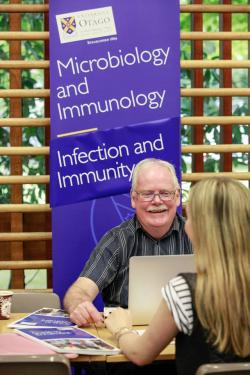
The Department of Microbiology and Immunology offers high quality undergraduate and graduate training in the fields of environmental, medical and molecular microbiology, genetics and immunology.
The curriculum is driven by current scientific knowledge, cutting edge research and reflects the needs of students, employers and the community. The Department ensures mastery of contemporary microbiology and immunology knowledge is attained, highlighting methodology and practice that challenges students to think critically and act independently. This will involve the communication of the importance of Microbiology and Immunology to scientific development and breakthroughs in environmental and biomedical research.
The Department provides an effective, supportive and healthy working environment and maintains appropriate facilities and equipment to meet the needs of staff and students. Graduates will attain an integrated knowledge of microbiology, genetics and immunology, and will demonstrate extensive practical experience in research methodology. An emphasis is placed on the ability to apply the principles of scientific experimental design and methods to investigate microbiologically relevant problems and an ability to critique scientific planning, data and literature.
Read more about the disciplines of microbiology and immunology
Microbiology and Immunology is offered as a major for a three-year Bachelor of Science (BSc) degree. The BSc will train you in all aspects of the subject.
First-year papers are taught through lectures and laboratory sessions and self-directed tutorials. Second- and third-year classes are also taught through lectures and laboratories, but encourage more independent thinking and initiative. In your third year, you will collaborate with other students and improve your oral communication and research skills. Laboratory classes are exciting and hands-on, with modern state-of-the art facilities. Assessment is by a combination of written examinations and internal assessment.
In your first year, which covers general subjects such as cell biology and human body systems, you will learn about the diversity of microorganisms, microbial virulence and diseases, and gain basic knowledge of the immune system and how it functions.
Your second year will introduce you to microbes, infectious diseases and the role of microbes in environmental and industrial processes. Topics covered include medical microbiology, microbial plant and animal interactions, biotechnology, ecology, environmental microbiology, molecular genetics and immunology.
In 300-level papers you will learn about contemporary topics using a hands-on and research-based approach. Topics cover food production and safety, microbial disease and antibiotic resistance, the body's response to diseases, biotechnology, applied and environmental microbiology and virology. You will learn from exceptional teachers who will encourage you to think critically and will introduce you to what will be expected of you in a career as a scientist.
This degree structure is essentially similar to the BSc programme, but has a broader biomedical base at 100-level with 200 and 300-level papers being orientated towards medical microbiology and immunology.
Two Microbiology papers are required at 300-level.
For further information on the BBiomedSc programme, see the University of Otago website.
Fourth-year honours or PGDipSci students undertake an original research project and can continue on to further postgraduate study, such as a one-year Postgraduate Diploma in Science, a master's qualification, or a PhD.
Find out out more about our postgraduate study options:
You should first contact the University of Otago International Office for admission requirements and financial support information.